To relish a rare balmy day in October, as well as to fulfil Dian’s yearly desire of soaking up the autumnal splendour, we repaired to Glen Tilt, a secluded valley in the north of Perthshire, where we were to set off on a day-long excursion.
One might find trails dedicated to spotting the nearly threatened red squirrels (Scotland’s only native squirrel species), such as the Red Squirrel Walk. Following such a trail, however, was deemed unnecessary by the two red squirrels who greeted us near the entrance before gamboling back in the woods. All around was a profusion of amber foliage of the maple trees, their sunlit star-shaped leaves forming a caressing canopy of canary against the balmy blue. Every now and then, a leaf left its home whispering, to submit to the rustling earth underneath.
Further ahead, as the reverberating sounds of the ongoing recreational shooting in the vicinity became amplified, we paused and wondered, in our naivety, if our track lay within the firing range, until our uncertainty was dispelled by a fellow couple, whom we had previously encountered. The couple were very familiar with the whereabouts of the place, for they had been visiting it for years. Their pooch, Kai, who was initially wary of nosey Clancy—even warding him off as, most small dogs do—merrily trotted alongside him once she witnessed her human companions walking and conversing with us, then intermittently returning to each of them to endearingly evince her loyalty. Before branching off, the widely travelled and long-married couple, describing what lay ahead, hoped that we relished the place, of which they had fond memories, as much as they did all these years.
A pack of kennelled dogs began barking incessantly as we walked past, while Clancy, who often pretends to be aggressive, reciprocated by simply marching ahead with his head down, in contrived silence—as if he never noticed the kennel or its occupants. Elsewhere, grazing sheep, pretending to fear Clancy, stayed stationary, each watching him with a mix of caution and curiosity, while the object of their preoccupation, in turn, sheepishly averted his gaze with mild apprehension.
It was beyond midday when we passed a convex stone-arch bridge from the 18th century, named the Gilbert’s Bridge. Adjoining the foot of the hills, the path ahead seemed inviting and the landscape bewitching, but, unprepared for the dusk, we chose to conclude the excursion, promising to return for an extended hike on another day.
If one wished to simply be swathed in the serenity of Scotland for a day without roving, then to Glen Tilt they ought to be going, for the walk affords vistas of a forest, a gorge, the moorland, the hills, a river, the waterfalls, and the bucolic. There was so much beauty to imbibe: from the silvery rocks with waves engraved on their burnished facets to the honeycombed patterns of chatoyant light dancing in the brooks (rippling caustics); from the warm hues of the tilted trees to the ever-shifting dapples of light and shade over the undulating hills near and afar. Autumn was indeed in its full glory in this microcosm of Scotland that Dian found through his peculiar ways of traversing satellite imagery.
P.S. During the onward drive, I was reminded of the plight of pheasants when we alarmingly came close to one on the motorway. To my great relief, the unspeakable was averted. On the A9 road in Perth, more than 32 pheasants had lost their lives. Why do these pitiful creatures approach busy thoroughfares, and why, when faced with oncoming traffic, do they exhibit poor reflexes? In writing this, I have learnt the sad truth: pheasants are considered game birds; raised in captivity without parents and released for the thrill of shooting, they lack the ability to take timely flight from danger. A gossamery existence is theirs, for they roam unprepared to escape the wheels that spell their doom.
The pandemic of 2020 brought a brief reprieve from the wearying rigmarole of the needless daily commute, a routine that had reduced me to an automaton. It also brought me closer to my hometown, which I had left fifteen years ago in pursuit of worldly aspirations; to its abundant nature and wildlife (the latter, quite literally); to Clancy, the dog I had taken in only a few months before; and to Dian, my husband, whose long journey from his mountainous hometown to be with me evinced an endearment far greater than my feigned coldness merited at the time.
With uncertainty and anticipation, we left Bangalore for the embrace of a hometown where Mother had purchased a flat whose carpentry and painting were still under way, much to my dismay. In the interim, we stayed in the coastal town of Mulki, at Ajji Mane, the humble home of a dear auntie and our ancestral sanctuary, surrounded by sincere love, simple things, and a rich profusion of lush green.
Fascinated by the native flora in Mulki, Dian would amble around and beyond every morning, bringing back a variety of plants to “propagate” them in our respective hometowns and the cities where we worked. Wherever we meandered in the monsoons, the tropical plant kingdom exhibited its variegated opulence. One would find a singular cordate leaf of the Caladium, glazed and speckled with pink and white, rising from dense clusters of other foliage, such as the Colocasia with its matte leaves finely streaked with dark interveinal shadows. Even decaying leaves held their own charm, their brown tissues juxtaposed with the green remnants in an organic mosaic. Withered clusters from teak trees were easily detached by a breath of breeze. One such cluster (called inflorescence or panicle in botany) came to rest on the rooftop of my grandmother’s lonely abode, a stone’s throw away from Ajji Mane. Draped in cobwebs, the panicle looked divine in the sunlight as I twirled it, its hollow seeds evoking the bells of a tambourine. Halfway between grandmother’s and Ajji Mane, scarlet seeds of rosary peas still bejewelled a familiar path by a brook, their continued presence a comfort to the nostalgic.
Caladium Amongst Colocasia
When we finally moved to the new flat, in a new village, I began to adorn the freshly painted interiors with furnishings in the designs and colours that I fancied, my endeavour turning into a project that I now regret undertaking, as I have since moved westward.
Kodangallu is a temple village surrounded by verdant forests where leopards, monkeys, peafowl, porcupines, pythons, and other wildlife live and, hopefully, thrive. I am certain that these creatures inhabit the forests, for I encountered each one of them during my very long sojourn, except for the porcupine, though I did stumble upon its quill.
Most days were spent exploring the unfamiliar village with the eager neighbourhood children, who would never miss an opportunity to join us on our walks, even if it required them to seek permission from their parents. The young bunch was primarily drawn to Clancy, who, having instantly become the cynosure of all eyes, basked in the attention and affection lavished upon him. Among the merry group was one particularly boisterous and adventuresome boy, whose boundless energy seemed to take Clancy’s fancy, as evidenced by the celerity with which his tail wagged whenever the boy approached. The boy’s animated anecdotes also enlivened our gatherings with laughter. In time, with the children’s help, Dian learnt to converse in the local language, becoming a favourite figure among them.
Together, chasing sunsets, we discovered several nameless local gems, many of which we came to inanely christen ourselves, such as a serene grassland frequented by a murder of cawing crows at dusk—referred to as Greenland in our conversations; a hill off the beaten track offering sweeping views of the surrounding forests—nicknamed 500 Hill after Dian lost a 500-rupee note upon its shrubs; another hill from where one could embrace all the glories of a golden sunset—christened Cake Hill, because a section of the hill appeared neatly cut away when viewed from a distance, resembling a sliced cake; and a desolate terrain dotted with shrubs that attracted vibrant bugs such as the Catacanthus—nicknamed Redland for its lateritic soil.
One of the places that Dian discovered through the map for our rambles was yet another hill whose local name, Naayi Basadi, translates to “dog memorial”. While we did find an ancient memorial on the modest hill, that it was erected in honour of a canine companion seemed far-fetched. From here was visible a large granite monolith called Konaje Kallu, which I had climbed as a child with my parents—our only hike together. On one side of the hill sprawled a forest, while on the other stretched coconut plantations where, looking through binoculars, one would find monkeys atop the trees, devouring coconuts or grooming one another. These playful primates were also early risers, as I discovered on New Year’s Eve 2021, when I woke up at dawn in high spirits—as though I were embarking on a new chapter of early mornings—and headed to the familiar hill to proudly watch the sun rise. Barely had I arrived when the monkeys began their ascent up the hill, resulting in my rapid retreat. It was also on this very hill that I spotted a leopard one evening! Though the sighting was fleeting, it sent me into such transports of delight that I remained on cloud nine for days, boasting about and marvelling at such a rare encounter with wildlife. As I recall this incident, I shall also record in writing a late evening when, as my young neighbour and I were approaching the flat, her sudden scream and retreat alerted me to a python lounging only a mere feet from where I stood! While her reaction was one of understandable fright, might I say that I was more exhilarated than frightened.
Some afternoons, the skies were cerulean, speckled with clouds bedazzled by the sun, and some evenings, they were kaleidoscopic and cathartic. The mesmerising ether formed an ideal sight to behold (and time-lapse) when listening to ethereal music.
On one of our rambles in an interior neighbourhood, we stumbled upon a garden with plants whose lush leaves were marked with hues of maroon and pink. Upon asking the owner if we could borrow a stem, she generously proffered several of them—a gesture characteristic of most people living there. I later learnt that this enchanting plant is called Coleus, and that the colour of its leaves depended on the soil in which it was rooted. Of all the variants of this shrub, the one that later grew in our abode was my favourite, for its leaves bore an exquisite pink, and if one looked closely on a summer afternoon, its velvety leaves glittered in the sunlight. I could easily recognise when the plant needed water, for there was a stark contrast in its appearance between when it was thirsty and when it was not. For a botanical novice like me, these little indicators were rather intriguing.
A stray puppy entered our premises, and subsequently our lives, like a radiant rainbow. Our first glimpse of her was in the moment she was struck by a car. No sooner had we reached the spot than she vanished, nowhere to be found. Days later, we discovered her outside the flat: unshaken, safe, and sound, albeit bearing an abrasion. With some love and food, she came to trust us and became our constant companion, tagging along wherever we went and whenever, rain notwithstanding. Full of beans, she was fiercely protective of the older Clancy, warding off any street dogs who approached him with suspicion. Upon this radiant pup, we bestowed the name Radium.
Inspired by Dian, who would bring home an array of wildflowers for me and wild plants for the “propagation”, I began to observe the abundant flora surrounding us, and to collect fragments of certain plants to propagate in our growing collection of vibrant pots. During this period, I also amassed a plethora of pictures of the native flora and fauna. Among the many plants I photographed was a youthful sacred fig, defiantly and beautifully sprouting amidst concrete in a college playground. Her mature heart-shaped leaves exhibited an array of green hues, while her emerging leaves were lustrous and reddish maroon. Each leaf was embellished with delicate dots arranged along her veins, evoking the image of celestial entities scattered across a cosmic canvas. She cradled more buds, each a promise of foliar splendour, until one day, when she was obliterated in the name of weeding, like other cherished elements in our vicinity.
Our next journey from Bangalore to Kodangallu carried a sense of pure relief, for we were, at last, joined by feline passengers, Dora and Mabel. Driving in a modest hatchback with a misunderstood dog and two decidedly mistrustful cats was not disruptive after all. While Dora, ever curious and adaptable, explored her new surroundings (albeit within the confines of the flat), Mabel plotted yet another escape. This time, however, her attempt was successful—she vanished into the wider woods, leaving us to ponder her fate.
Every day, Clancy tried to discreetly befriend Dora, who eventually came to tolerate his presence but never stopped hissing whenever he ventured too close. There was an undeniable joy in watching this one-sided courtship, in his tireless but doomed efforts to win her approval. There was also a certain joy in watching Dora bask in the afternoon sun reposed on a beanbag and take a siesta, in my very native land.
The abundant richness of flora and fauna, coupled with my serendipitous encounters with wildlife, was part of what made the region so dear to me. Equally significant was the chance to share the place and its experiences with my pets and with Dian, who never once minded the impromptu arrangements or the background cacophony during work. Despite never having had a dog before, he seemed to effortlessly understand Clancy (while I signed up for a training on how to read and interpret dog body language), and treated him with a tenderness that I, for all my affection, lacked. In so many ways, he was so unlike me, our differences only shining a redemptive light on yours truly. Until then, the longest time that we had spent together under the same roof was during the pandemic—an isolation that brought us together as we rambled through the tropical treasures.
P.S. During my brief absence from the village, Radium was beaten and banished by a man, because his shoes were torn apart. Failing to find her upon my return, I asked the shopkeepers nearby of her whereabouts, but none had seen her. We never learnt what became of our beloved Radium. The man, whose day job was to safeguard wildlife, had at home a toddler who was teething—just as Radium was at the time. As for Greenland, reduced to concrete, it exists no longer, as many places are, in the name of “development”.
The wait in Salzburg – A frolicsome terrier – Salzburg to Strobl – Appeal of the Alps – The guest house – Strolling through Strobl
Early summer, we hiked across the lakes, rivers, and hills of Austria, fanatically picturing the picturesque environs, like rivals on a photography assignment. Our journey began in Salzburg, where we were to board a bus bound for Upper Austria. While we were kicking our heels at a bus stop, the rain god made a grand appearance, driving us to enter a bistro whose fancy lights had caught my fancy as we scurried across lanes.
A silvery terrier came hopping to us when we presented ourselves at the entrance. Throughout the period spent at the bistro, I could hardly desist from entertaining—by means of caresses—the little creature whose frolics had captivated me. Every time she sensed the presence of a visitor, her desire for attention would make her scamper towards the entrance, and soon, to realise the very same desire, she would run back to me with unaltered buoyancy. So reluctant was I to bid farewell to the dog who effused such generous warmth.
The appeal of the Alps was apparent from the time we boarded the bus, as we glimpsed a profusion of lambent lakes girdling the glorious mountains in the cobalt shades of evening. On a journey far away from my base, the humble acknowledgement of my beloved’s presence elated me more than the gorgeous sights.
In Strobl, lugging the heavy bag along the road to the guest house, I could not but acquiesce in his opinion that I should have carried a backpack instead of a tote bag. The fetching accoutrements of the guest house, which was equipped with all the thoughtful comforts one is likely to possess in his own abode, revived the delight taken by a child in stumbling upon the bits and bobs for a domestic pretend play. Porcelain jugs with floral motifs adorned the tables and the sill of a window that was clothed in white lace curtains.
That cold night, we soundlessly walked to a spot not far away, to admire from afar a faintly lit dwelling—a sight that evoked an image from my nocturnal amble in Portree. The next morning, we set out for a stroll through Strobl.
Vying to aesthetically picture a parish church, we crossed a boggy field through which ran a creek that shimmered in the sunlight and, as he indicated, reflected the slumbering mountains in the distance. Strolling further led us to a pathway that was lined by birch trees. With the Salzkammergut Mountains on one side and Lake Wolfgang on the other, we were presently in the nature reserve of Blinklingmoos. The abundance of verdant fields and the recurring sight of the locals pedalling bicycles underlined my father’s description of the place a decade ago. Indeed, it had been the reason that I chose to visit the landlocked mountainous country.
Chapter II
Strobl to St. Wolfgang – Mural flora – Bird silhouettes – St. Wolfgang to the Mozart Village – The secluded shore
That cool, sunlit afternoon, the residents of the village were out on the patios with families, celebrating the festival of Easter. On account of the holiday, the steamer that was to depart for St. Wolfgang, which is located on the northern shore of the lake, would not return to Strobl. Nonetheless, we went aboard knowing that the villages were well connected by buses.
Near the waterfront in St. Wolfgang, the endearing sight of a man holding a dog in the manner of a parent holding an infant, and that with such warmth and constant attention, made it exceedingly hard for me to avert my gaze. My obliging partner, Dian, stood beside me until I reluctantly declared that I had better proceed. Of what geographically lay ahead we were unaware and perhaps a trifle disregardful, for sometimes there is pleasure in merely wandering about an unfamiliar town, so long as the town has a footway or you have a terrific companion.
In a marvellous amalgam of two terrestrial elements—one manmade, the other natural—the exterior walls of some structures in Austria are graced by vines that eventually colonise them. This phenomenon of mural flora was so foreign and striking to me that my botanically challenged mind wondered if it could occur at all in a tropical country.
On the panes of glass-walled bus shelters were fixed stickers of bird silhouettes—a tactic used to deter birds from fatally crashing against the transparent panes. Picturing the stone veneer of a medieval church, my eyes fell on a poodle who was snug in a basket attached to a bicycle while its human companion was engaged in conversation with her friend. Yet again, Dian exhibited unwavering patience as he waited with me until the furry object of my affection fled the scene in the bicycle. We walked past the picturesque pastel-coloured buildings lining the speckless streets, and then continued the journey on a bus bound for the Mozart Village.
Our brief stroll in St. Gilgen took us to a flower-laden churchyard, and then to a secluded shore of a lake that, to the delight of my lover, afforded a view of the snow-capped mountains and the lulling and undulating hums of mellow waves, and to mine, afforded the sight of a tabby cat. While he attempted to accurately record the sights and the sounds, I pursued the capricious cat until the latter tired of me and quit the spot.
Beside the shore was the birth house of Anna Maria Mozart, mother of musician Maria Mozart and composer Wolfgang Mozart, and further ahead was a shop that sold cuckoo clocks for souvenirs. Both remained closed on account of Easter. The azure sky had deepened into sapphire, and at last, the pendant lamps were illuminated to bedeck the still streets in the gloaming. The scene having then optically altered to my liking, I engaged my humble camera until we reached the bus shelter where we were to board a bus back to Strobl.
Chapter III
Strobl to Obertraun – A gorgeous river – A coniferous forest – The guest house in Obertraun – A night by River Traun
From my travel memoirs, Dian had deduced, rather incorrectly, that to connect with a beauteous place such that my experience is enhanced, I should see the place in his absence. Notwithstanding the demurrals I offered at his misguided proposition, he persuaded me to see Strobl unaccompanied the next morning.
Presently dismissed, I ran through the nature reserve of Blinklingmoos, retracing some of the steps taken the previous day. A pair of geese was peacefully floating in a creek; geese, I later observed, were always found in pairs. Upon the unstirred lake, the mountains sketched their mirror image for the absent companion who found beauty in such precise reflections of nature—the one whose deduction was proven false after all.
The same morning, we left Strobl for Obertraun, a valley backdropped by towering steep massifs. When you are accompanied by a breathing alarm clock, you can rest assured that you will not miss a public transport. Thus, we always arrived at a station ahead of the vehicle. Then having reached the guest house in Obertraun many hours ahead of the check-in time, we chose to see the immediate vicinity, while our cheerful host prepared to arrange our room.
Within a stone’s throw of the house ran a gorgeous river with a bank bespangled with white pebbles. In its frost blue water swam a few swans. On the opposite riverbank was a forest with tall upright trees with plumy leaves shrouded in swathes of shades, notwithstanding the circumambient daylight. We ambled along the riverbank until the eyes of my breezy partner discerned some flowers in a raised clump of shrubs, whereupon he clambered onto them (akin to a bee, he is attracted to flowers). When he later emerged from the bristly bushes, to my pleasant surprise, he proffered to me pink, purple, and white flowers.
The two riverbanks were connected via a road bridge. Crossing it, we found ourselves near the accessway to the coniferous forest which was not tenebrous after all. Here, we stumbled on flowers with yellow pistils and five white petals whose stalks arose straight from the earth. When we found snow on the brink of transformation, we hastily formed deformed balls out of it, and began to toss the melting snow balls on to each other. Of course, I failed terribly in the game of aim.
An oblique pathway lined by the evergreens led us to the riverbank where little pools reflected the snow-capped mountains, thus serving as the subject for Dian’s subsequent photography. The ubiquitous Alps were the source of the cold river, and the river the source of Lake Hallstatt, a popular destination among tourists. We found more flowers that sprang straight from the ground, projecting skyward.
Our hosts in Obertraun were a couple from England who, with their dog, had moved to Austria to live the life they desired. Before it was renovated, the guest house had been a farmhouse. We spent the evening mostly indoors, basking in the mellow light in the balcony, laying around an ornamented dining room listening to the folk music of the Alps, chomping on a homemade chocolate cake, and admiring the animal-themed bibelots, one of which reminded me of my beloved cat, Dora. When night deepened, we silently strode to the riverbank, hoping to see a galaxy of stars. Sparsely occupied by stars, the sapphire sky emphasised the whiteness of the pebbles and the snow on the encompassing mountains.
Chapter IV
Contrails – Hallstatt Skywalk – Tourism in Hallstatt – Lake Hallstatt – Dachstein Mountains – A muted swan – Burgeoning creepers
Every so often in Obertraun, multiple condensation trails furrowed the blue sky. The next day, in the hope of spotting a herd of deer, we took a route that paralleled a fenced deer park, but no such luck. A tributary ran parallel to the same route. Stumbling upon any watercourse meant that my companion would abandon me to ceaselessly engage in filming the stream.
Our path in the Obertraun valley, for the most part, was devoid of people. In Hallstatt, however, the scene was very different. Apparently having gained more popularity in the digital sphere from the dusk images of a parish church by the lake than a prehistoric salt mine, Hallstatt was bustling with tourists on that balmy day. Ironically, the very church had no visitor.
We took a cable car for a tour of the white gold mine located 2,600 feet above sea level in the icy mountains. The Hallstatt Skywalk, a viewing platform, was sought by most tourists to whom the wonderment of the vista was superseded by the desire to get the right shot. From the platform, one could see Lake Hallstatt with its varying shades of blue, and the tiny town shaped like a slice of a pearly pie. Before returning to the ground via the cable car, we tried to make the most of our surroundings by forming snow balls to attack each other with all our might. One time, when I was preparing to pose for a picture such that I would dramatically turn towards the camera on the count of three, my evil partner launched a snow ball right at my grinning face.
Tourism in Hallstatt came at a price. The inconvenience of the residents at the tourist overflow was evident from the placards some had rightly posted on their doors imploring tourists not to invade their privacy or leave their belongings at the doors. It was madness to wait until sundown for a picture of the illuminated church. Yet, so many tourists, including my partner, bided their time. During this period, we sauntered up and down the winding thoroughfares, admiring the creeper-draped pastel structures, stroking (after stalking) the tabby cats that crossed my path, besides looking high and low for a suitable eatery in vain.
Across the market square, walking down a sunless alley alongside a yellow wall, we reached a pier leading to the lake. The faint pink glow of the evening sun reflected on the chalky crest of the Dachstein Mountains, which rose on the other side of the lake. Presently, in all his glory, a mute swan emerged before me; he broke his drift to flutter his majestic wings, leaving concentric ripples on the opalescent surface, before ebbing away, back into the lulling waves.
With the nightfall lit the church. Swans, their snowy plumage sparkling against a dusky surface, floated near the rim as we left the town of burgeoning creepers.
Chapter V
Leaving Obertraun – The railway station
The next morning, we went to see the river before we bade her farewell. After all, it is seldom that one finds a setting encompassing not one but many geographically attractive facets of the Alpine landscapes: a river running along a forest surrounded by mountains.
Keen to imbibe the allure of the valley one last time, Dian, with childlike gusto, pranced about the pebbled bank. Tufts of dense and opaque clouds had been softly traversing the crowns of the conifers. It appeared that for every tree felled in the vicinity, a woody sapling had been planted. In the adjoining forest, the ferny turf was sprinkled with white and purple blossoms whose slender stems, concealed in a viridescent vegetation, emerged from a damp earth. Having ensconced myself on a gigantic sappy log as a thin drizzle skimmed the bank, I could not but allow slumber to take over me.
At the unfrequented railway station in Obertraun, a pair of tourists with whom we had shared a taxi from the guest house learnt, rather sadly, that the train that just left the rails was the one for which they had been waiting. They were worried particularly because they were to catch another train from their first destination, Salzburg, which was over two hours away via train, and the next train bound for Salzburg was scheduled to arrive much later. What compounded their dismay was that when the intended train had braked for passengers to board, they were on the platform—it must have been the mistakable signals, coupled with the language barrier. (If I were journeying in this country on my own, I would have encountered a similar situation on a goodly number of occasions.) Perturbed by their collective frown was Dian, who, with an apologetic countenance, held himself remotely responsible for their predicament as he muttered that it could have been averted if only he had inquired where they were heading when he earlier found them wading through the information systems. Although I argued otherwise, the episode unearthed before me another one of his virtuous traits—empathy.
Chapter VI
Our journey’s end – Styrian architecture – The miniature room – Hike across Grundlsee – A belligerent pug – Undulating greenswards – The ethereal atmosphere – Epiphany
In their idyllic seclusion lay the appeal of most places we visited in Austria, where, at any given spot, almost always, we were the only ones to descend from the bus. Indeed, we took pride in our choice of places to sojourn in. One such place was situated precisely at the further end of Bad Aussee, in the village of Anger, our journey’s end in Austria. From up there, the only conspicuous activity was the continuous slide of a cable car that transported gypsum. On either side of the oblique road, which ran alongside our quaint interim abode, lay undulating grassy leas backdropped by vast mountains capped with fading snow.
We quit the quietude of our guest house to pick a few edibles at a supermarket, wherefrom we plodded further down until we saw a park near the Mercedes Bridge. Presently perched on a bench, we admired the swift passage of the entire luminescent cloud population, which never seemed distant in this geographical centre of the country. A glance at the sky and one forgot his mundane existence.
We chanced on a seemingly shorter course to our guest house—one that partially comprised flights of stony staircases and alleys. The residents were obliged by law to uphold the traditional Styrian architecture, and thus, construction or modification of a house could not result in a façade that deviated from the pattern. Once indoors, I could not resist the snug comfort that our Lilliputian space offered. Enveloped in the miniature room, I embraced the sheer stillness of a cold cerulean twilight as I tranquilly watched clouds shift, through a glass window.
By this time, mindfully governed by our vanities, Dian and I had taken to comparing our respective travel pictures towards the end of each day, each declaring the other’s pictures unworthy (while, deep down, each considered the other’s pictures to be enviously appealing). With no destination in mind when we set out the next morning, we allowed our whims to drive our course, and thus met our eyes the rolling countryside.
We followed a forest glade until we sighted a vista of greensward to reach which one had to trudge over yards of glassy snowmelt. My inexperience with such terrains had me wading my way through the snow-laden path while Dian, who had already reached the periphery, began the snow attacks. Further ahead, past an abandoned log house, we found ourselves in a sparse neighbourhood where, delighted to find a pair of dogs romping around together, I made the folly of attracting them by the tongue-clicking sound. As a result, one of them, a pug, came charging towards me, barking incessantly. Thankfully, no anomaly occurred, for its neighbour appeared to dissuade the little creature from fulfilling its urge. For the remainder of the journey, I reluctantly refrained from attracting the attention of the dogs I espied.
Our rove about the sleepy villages took us to Grundlsee Lake, and then, briefly into a forest where I glimpsed a deer before it disappeared into the woods. The sunbeams glistened upon the white petals of the poisonous Christmas roses and on the spider webs between the twigs of withered trees. Outside the woods, by the side of the road, lay discarded beer cans.
After we returned to the guest house, I ruminated on our earlier unwitting inclination to set out to a destination away from our beauteous locale when the latter exhibited the elements of ecstasy. Consequently, before sundown, we left the guest house again, hoping to find a path to the grassy leas that sprawled in the vicinage.
We frolicked on the greenswards, celebrating the glorious rays emerging from the crest of a distant mountain and piercing the surrounding trees, whose leaves were now a bed of russet foliage complementing the blue-violet liverleaves. In the dwindling light, we discerned a solitary iridescent cloud.
The high cumulus compassing the distant mountains had broken up to scatter the mellow glow of the evening over the rolling sward. A mound of conifers in the purlieu was saturated with sienna. Rambling further across the undulating fields, we reached an expanse of green meadows carpeted in a rich profusion of white crocuses, which, from afar, appeared as drops of snow hailing from the curtains of ice that draped the omnipresent mountains. Enraptured by the enveloping aureate light emanating from a sun obscured by the passing puffy clouds, I lay supine amongst the flower buds pearled on the soft grass. As I shifted my gaze between the ethereal upper atmosphere flushed with the pink of evenfall and the noble figure roaming about the verdant fields in awe of his sublime surroundings, I was imbued with love and contentment.
Now writing this memoir in a city far away from the calmness of the bewitching valley and the glorious mountains, I like to imagine the Obertraun River still running, and the swans still floating on her frosty blue surface. Perhaps, a descending sun still casts a roseate glow on the white curtains of the mountains seen from the swards in Bad Aussee. When, even in the fullness of time—regardless of where I am currently—these places evoke a sense of harmony and peace that was felt when I first beheld them, I can aver that a journey can be positively consequential, notwithstanding the voyage of time.
P.S. The title of this memoir is borrowed from a song in The Beggar’s Opera by John Gay.
In anticipation of Barbara – Loch Lomond – Highland Clearances – Scottish folk songs – Sheep pastoralism – Windstorm
My journey to the Scottish Highlands coincided with the tidings of the arrival of Storm Barbara, and thus devoid of excitement, I embarked on the tour bus across George Square in Glasgow City. Immaterial became the itinerary, and I allowed slumber to conquer me. Despite such assumed dispassion, I must note that I was quick to exit the bus during every stopover.
On the shore of Loch Lomond, pompous ducks with speculum feathers of amethyst and emerald hues swam past me, with an air of superiority. A strange rainbow had then just emerged above the horizon, causing my gaze to alternate between the floating flock and the painted firmament far away.
The ride through the snow-capped mountains was made merrier by the soothing music played by Martin, the busman. He narrated the historical events surrounding the places he espied and expected his passengers, the tourists, to marvel at. However, in my ceaseless attempts to snatch forty winks, such noteworthy accounts went unperceived.
Akin to a berceuse, the Scottish folk songs—some of which connote the pith of consolation accompanying an era cursed with widespread diaspora and anguish resulting from the infamous Highland Clearances during the eighteenth and nineteenth centuries—transported me to a world where absolute empathy was omnipresent. Very few are capable of conveying solace through words, in good faith. Hoping to listen to such pacific songs upon my return, I asked Martin for their titles.
Sheep pastoralism in the Scottish Highlands came about in the eighteenth century at the expense of their inhabitants, who were brutally forced to evict from their lands to make way for the flocks. Sparsely populated by humans and densely populated by sheep today, the cold mountains still remember the horrid past.
Often during the journey, I wondered why the sheep one found grazing in the remote mountains had their fur dyed in a colour different from that of the flock grazing elsewhere. I later learnt that colours helped shepherds identify their flocks, lest the sheep divagate or fraternise with the neighbours.
Thrice during the ride, the roof window of the bus submitted to the fury of the windstorm and flipped open, leaving me wondering if Barbara was in our neck of the woods. When Martin enquired if any of us wanted to take a stroll in such harsh weather conditions, I threw caution to the wind and volunteered. (I declare that my foolhardiness has no end.) A few passengers followed suit.
In the raging tempest, I found myself on the verge of being lifted off the ground. Thrown off balance, literally, and aware that my palpable existence had no bearing on the gusts, I held onto a rock with all the strength I could then muster. Disheartened by my inability to continue walking, I sat on the rock resisting the vehement winds when a fellow passenger enquired if I was fine. The benevolent girl lent me her hand as I replied in the negative, and we both resumed the formidable stroll with our hands clasped, in an attempt to withstand the violent gusts.
We returned to our seats windswept. I began to wonder how Martin could venture out with a single layer of clothing while the rest of us were almost always upholstered in layers of overcoats, mufflers, earmuffs, gloves, et cetera.
Chapter II
A night in Portree – Coastal towns – A lone house – A transcendental experience
My nights on the Isle of Skye were spent in the quiet town of Portree. One morning, as we were leaving the town for the day’s journey, I glimpsed a sea from the bus window. That I had spent the previous night cloistered in the hostel instead of exploring the town—where lay a sea—made me resolve to spend the night outside, upon my return the same day.
Coastal towns possess a certain aura which reminds one of his place in the cosmos and of his gossamery existence against the expanse of the ocean. My roots are in a coastal town named Mulky. Albeit I grew up elsewhere, over time I have come to realise that I have a special connection with the small town, in its entirety—its thalassic air, red lateritic soil, seaside odour, casuarina trees, thunder bursts, and baby coconuts. Merely writing about it makes me want to be there this very instant.
That night in Portree, I went in search of the sea. The inclined roads were punctuated by my dear subjects of shooting: street lamps and trees. The cold was intense, and I was carrying one too many things in my numb hands. More than once, the bread, which was to be my supper, fell on the pavement—a realisation that came upon me only after I had walked a few yards ahead.
I remember being so mesmerised by the sight of a lone house in the dark that I stood opposite the picket fence for some time, gazing at the little house, thinking about the minutiae of a domestic, conjugal life. As much as I tried to resist the sight, I found myself walking back, clandestinely gazing a little more, at the only house far away in the rolling grasslands. Aware that my action was akin to that of an interloper, I unwillingly quit the spot later and continued to walk, occasionally stopping by the street lamps.
Some surreal photographs of the places I had seen on the National Geographic magazines in the early two-thousands are still etched in my mind’s eye. Fueled by music, I have retreated to these places in my mind numerous times and received tranquillity. In the pursuit of finding the sea, some fragments of my imagination appeared before me and sent me into transports of delight. The atmosphere was embellished with a blanket of heavenly entities. Never had I beheld such a stunning constellation of celestial objects in the real world. In a moment of ecstasy, essaying to embrace the exquisiteness of the empyrean sphere, I began to spin round with my gaze lifted to the entrancing sky, watching the illuminated entities envelop the outer space and imbue my core with a deep sense of contentment—I felt in unison with Mother Nature. Such transcendental experiences, albeit ephemeral, impress upon our psyche; and when the meaninglessness of life has overwhelmed us, evocation of these very experiences enkindles feelings of immense gratification and fills the lacuna formed by the decay of love.
The road ahead of me did not appear to lead to a shore. So, I retraced my path until I found a parallel roadway that sloped downward. It began to mizzle, but I kept walking because the prospect of finding my destination seemed likely. I heard the steady flow of water near a stream facing a bungalow. I saw withered trees in the light of street lamps. At last, I met the sea. She was cloaked in aloofness, while the harbour lights were still burning. The inconspicuous shore was unwelcoming. I pondered vaulting over the natural barricade of coastal thicket to be on the shore, but desisted from it, for fear of stepping on the nocturnal sea creatures in the night and disrupting their peace and quiet.
After a night of perambulating the twisted and tilted roads of the placid port town of Portree, I returned to the youth hostel.
Chapter III
Moorland colours – Eilean Donan Castle
The predominant colour of the hills in wintertime is an ochre yellow. Come summer and the moorlands of Skye are carpeted with the mauve of heather. The Inner Hebrides had lost their fetching purple hues by virtue of winter, long before my visit. I could only imagine how appealing the sight of hills sheathed in purple heath would be.
In his quest to claim power, man has marred many a magnificent place. Eilean Donan Castle, which is encircled by a loch, has endured renovations since the thirteenth century. I had about an hour’s time to explore the castle whose last renovation took place in the twentieth century. The ethos and the charms of a bygone era were entrenched in the wakeful windows and the fortified walls of the castle. As I meandered through a series of empty rooms and glimpsed the charming appurtenances of the foregone times, the minutiae of everyday life in the face of perpetual skirmishes hovered before me. From a hole-in-the-wall of a dark and narrow passage, I watched a few birds waft over the jittery gray waves, against a stormy sky. Passing by a little room where entry was prohibited, my eyes fell upon a white skull mask hung over a window in the room. I slunk in to discover that it was a storeroom for decrepit items from the modern era.
In a faux kitchen-diner, I was riveted by the intricate wax sculptures set in a domestic scene of the nineteen-thirties: hearty women cooking up a banquet, finicky servants arranging the dining table laden with sumptuous items of food, a butler scrutinising a salver while a calico cat stravaiged about the banquet hall. I do not quite recollect seeing other figures of men; perhaps, the gusto with which the women in the kitchen were performing their domestic chores was attributed to the homecoming of the gentlemen—strictly, my fancy. Nevertheless, the setting was one of merrymaking and opulence, and the diorama of domesticity with such ornate particulars of punctilious mien and cooking was outstanding.
Chapter IV
Lochside woolshed – Snowfield – Sisterhood
Since a certain castle listed on the itinerary was closed to visitors, Martin decided to take us to a lochside woolshed. At our unintended stopover, the woofing of two mountain dogs halted my pace. The next few minutes were spent fondly stroking them and watching their hoary and tawny eyes mellow with delight, while the fellow passengers trooped after the guide. When one of the flock guardians began to gambol amid gusts of wind, my reluctance to shift the gaze was further reinforced. Consequently, I was the last person to reach the woolshed where the shepherd, who was also a shearer, had been describing the method of wool shearing. In the manner of curious hosts, the robust sheep—knowing that they had visitors—gleefully paraded before us and towards the shepherd, one after another. Upon realising that neither their master nor the guests had something to offer, they dawdled back, in sequence.
The shepherd’s dismay was evident as he spoke of the state of affairs in which the fodder for the sheep was much costlier than the subsidy they were provided, thus jeopardising prospects of a secure livelihood.
The coy sun had finally made an appearance in the Highlands. Beholding, from the window of a bus, vast swathes of hills canopied with snow sent me into raptures; their exquisiteness dampening my eyes and awakening emotions of all-encompassing love for Mother Nature and my sister, the epitome of optimism. I imagined how delighted a dear friend of mine would have been, too, to see wondrous places such as the ones that touched my core and suffused me with sanguinity.
My co-passenger during the journey was a Brazilian named Fabiana, whose eyes would glint with great delight whenever she looked at beauteous sights. Often, I would find her engaged in soliloquy as she filmed her idyllic surroundings. Yujin, the girl from South Korea whose benevolence in the face of a windstorm had moved me, and with whom I had shared a room in the youth hostel, took me by surprise once again when she gave me a box of short bread before we parted and said that they were for my nieces, about whom I had spoken so fondly one day. The two women were on their own in the United Kingdom. When the journey ended and the farewells exchanged, I began to think about the vastness of the ecosphere and the sundry experiences it could offer to someone who is willing to explore and embrace it, in good faith.
What a strange place, I thought, glancing at a vagrant with a jolly countenance, accompanied by a dog, greeting passers-by; a boy spreading a blanket over his girlfriend, who was curled up on the busy pavement; and a hopeful man with a cardboard sign stating that he is in the fourth stage of pancreatic cancer, amid high-rise buildings and chic crowd—the highlights of New York City. A few days prior to my visit, I had stumbled on an article that recounted the lives of homeless millennials, and here I was on a wintry night, flanked by them.
By a crosswalk where I had been waiting, a man appeared before me and remarked, with gleaming eyes and assumed familiarity, that he was “embracing movements” in a fast-paced urban milieu. At the adjacent subway station, I was amused to catch a glimpse of a group of drunken revellers baring bosom and buttocks to each other with humour, in a New York minute.
It was the night of Halloween; moving past Daenerys Targaryen, a man clad in a black bath towel, some vampires, and discarded postiches, I was convinced that the city dwellers did not entirely lack the ardour surrounding the festivity. Miniature dogs crossed streets with their pretty guardians. A man spat compulsively as he walked. One by one, the shops shut down, diminishing the horizontal city lights. As the vehicular movement was receding and people were making their way home, a bunch of youngsters hauled a trolley full of fast food down the sidewalk, for the homeless.
It was not the Times Square or the Empire State Building which captivated me that night, but the multitude of such diverse people. I wondered why the acquaintances whom I had met during my sojourn in New Jersey, which is not very far from New York City, suggested that I visit the most populous city in the United States, as they sang its praises. Is it distraction in the form of ceaseless movement of assorted masses which people seek, drawing them to a metropolis such as the New York City, or is it that people like to be associated with a place full of tall structures and fashionable people, perhaps to boost their sense of self?
It was nearing the end of autumn when I first flew to the west. Trees bore cherry red and yellow ochre leaves. Skies reflected a mellow blue. Nights seemed cold. The knowledge of my impending departure prompted me, on most late evenings after work, to walk around the neighbourhood and shoot the autumnal scenes. And thus, with some lovely pictures of dusk, I returned home.
Long gone were the charming colours when I next flew to the west. Upon unlocking the door to the house where I was to sojourn, I was taken aback by the amount of filth that had accumulated and, perhaps, aided breeding of pests. The sight of a mop, albeit cobwebbed, partly succoured my fastidiousness. Without a moment’s break since I crossed the threshold of the insect-ridden house, I began to scrub the living room, kitchen, and bathroom. Yet, there was an inherent odour which the incessant pumping of the air-fresheners failed to extinguish. The contents in the refrigerator were rotting. The water in the bath-tub would not drown instantly. It was sickening!
After three hours of cleaning the living space as much as the available resources allowed, I acknowledged that no amount of rigorous rubbing would eliminate the dirt, for the house was germ-infested due to an extended time of neglect.
***
One Friday evening, I sauntered downtown after work. The streets were lined with vintage cars of such striking paints that I fell head over heels in love with the myriad colours at the same time; purple and beige ceased to be dearest as I feasted my eyes on a rare blue, a certain magenta, and the candy orange coated on the antiquated chassis that belonged to a cohort who—judging from the exhibits—took great care of their possessions.
A Bisque doll head with aquamarine eyes seen from a display window drew me into an antique shop where, after a few minutes of speculation, I asked the store manager if I could photograph the objects in his gallery. Not only was he kind enough to reply in the affirmative but he removed the two identical doll heads (on which my gaze inadvertently remained fixed) from the shelf, and laid them on a bare wooden table, for ease of shooting.
When walking back, a nearly deserted train station outlined by arched lamp-posts engaged my lens for a very long time. Looking back, I now perceive that that summer evening indeed presented before me subjects I had not captured before: classic cars, antique dolls, and a train station.
Outside the Edinburgh Waverley station, I saw Marley, the brown dog whose master, a vagrant, had allowed me to stroke her when I was last there. This time, I was determined to observe my surroundings as opposed to the last time, when I had blinders on, and thus, I was able to assimilate the aura of the Old City with begrimed structures as I walked on its inclined roads. I missed company, dearly, when I toured Camera Obscura and World of Illusions. By listening to music and reminding myself to embrace the solitary life, I made an effort to lift my spirits.
I understand that it is ill-advised to walk to a dark and desolate place alone on a night, but seldom have I allowed such apprehension to deter me from exploring precious places. The trail to Arthur’s Seat was devoid of people and light, so naturally, I was drawn towards it.
The coincidence of a dreamlike place and a certain moment, and the acknowledgment of its realisation, caused sheer wonderment. Some sights can indeed move one to tears. Joy and gloom engulfed me as I beheld my surroundings. Of course, I was ecstatic to have finally arrived at a place akin to the one I had only seen in my mind’s eye years ago, but I could not stop brooding over the absence of a beloved companion to share my delight with.
The little pond glimmered in the light of the moon hung on the soft sky. Mesmerised, I lay on the damp earth, and watched a sequence of drifting clouds keenly brush the solitary moon. Soon, a forsaken tree called out to me. Placing my body on her withered branch, I caressed her wind-swept skin with love.
The asphalt jungle transformed into tremendous windmills when the first light, along with a gush of cold wind, woke me from a searing slumber of six hours. Across the vast wind farms, I glimpsed a young peahen, bewildered by the vehicular movement around her, take to flight. Further ahead, musters of peafowl foraging on the ground, followed by torso statuettes of a certain politician wearing a pair of goggles and emblazoned with elaborately sculpted garlands, were a common sight.
At the Pollachi bus station, bearing in mind the forty hairpin bends separating us from our destination, we settled aboard on a seat wide enough for bags, snacks, and two oscillating bodies. The fragrance of garden-fresh jasmine worn by a fellow passenger ousted the fetor emanating from outside. Our eyes were directed towards a white-bearded man who, with a bag full of white canisters, had embarked on the bus to give a brief but comprehensive demonstration of a wonder drug that, according to him, cured various indispositions. Lacking occupation on a stationary bus, we had, though unwittingly, assigned ourselves the exercise of reading his tongue—the local language—for when he finished, we found ourselves sincerely exchanging our interpretation of his disquisition. The “magic” bullets were bought by a handful of passengers.
For a long time during the steep ascent up the well-maintained roads, the Aliyar River, situated in the foothills of Valparai, remained in view, looking like a bed of irradiated white gemstones. The likelihood of seeing the Nilgiri tahr, among other wild animals, cast aside my somnolence. Once, during the sinuous ride, I heartily declared that I sighted a lone baby elephant, only to be banteringly assured by my witty companion that I was grossly mistaken, as an elephant calf is seldom without a herd.
Embracing the cold zephyr on that crisp day, albeit with chill bumps, I jubilated over the unveiling of endless winding roads flanked by kempt tea plantations. Our abode located across the Solaiyar dam had its own garden frequented by birds I had not seen before. Every now and then, the scream of peafowl, accompanied by the whistling calls of other birds, reminded one that their habitat was not far away. That afternoon, I ate ravenously, and sank into bed picturing a bygone figure by a dam at sundown, and sundown it was when I awoke.
The orange glow of dusk had transfigured the landscape, its elements robed in marigold, reflecting a mellow light. By and by, the splendour wore off, and in the cobalt afterglow, we ambled along the obscure, winding roads masked by gloom. The lambent flicker of fireflies brought vistas of surreal phases so sanguinely spent with the bygone figure in places alike.
Dawn was greeted with glee when the promise of sightseeing and wildlife spotting appeared before me in the form of a car hired for the day. Promptly, we hopped in and settled comfortably with our travel accoutrements. On the way, I saw men dressed in camouflage, peering through titanic lenses mounted on tripods—an exotic animal must have been in their neck of the woods. In the pretty town with tea plantations, interspersed among the estates and roads, were little placards that reminded an outsider to be a responsible visitor. The air, laced with the aroma of raw tea, was a tonic for the withered senses. Along an old tea factory, located near the Karamalai Annai Velankanni Church, was a coarse path leading to a spot that offered a picturesque panorama of a lush green meadow bordering a pond.
Before my eyes lay a painting of pastoral landscape, and I, bewitched by the radiant colours of the products of the earth, was drawn into the canvas to experience the loveliness of the world it held within. Under a mist-laden sky, slender trees had coyly sprung from the tea gardens to behold their reflections in the placid water. Gregarious cows and coltish egrets were engaged in symbiosis. Had the panther warning signs missed my sight, I would have perambulated the verdant fields to my heart’s content. The only house in the idyllic purlieu was hemmed in by an electric fence. After parting from the spot, we came upon a caveat—”Trespassers will be prosecuted”. Captivated by the glory of the setting, indeed we had not only encroached upon a private property, but also gazed at the quaint house, surveyed the electric fence, and captured the wondrous environs.
Upon our arrival into the hills, Sky Father had curtained the sun for a balmy weather. Between the chauffeur and us existed a language barrier that no amount of articulation or gesticulation on our part helped break. So when he reiterated the word “photo” as he brought the car to a halt, I supposed that he meant for me to alight at once to photograph the estate-ridden backgrounds, which I unquestioningly did. There I was, by the side of the road, releasing shutter after shutter whilst also seeking the aesthetic element he might have expected me to capture. Only later did it dawn on me that yet again, I had magnificently demonstrated my idiocy, for our inscrutable chauffeur had pulled over to speak to a friend on the phone, and the word “photo” had but stemmed from their conversation. Naturally, the entire episode had my companion in stitches.
Untiringly cautioning unaccompanied visitors against walking alone at Nallamudi Poonjolai, a viewpoint located within a tea estate, was an old gentleman named Nagarajan, who chose to escort us through the seemingly safe plantation, because we were only two in number. Only recently had a tiger preyed on a woman at dusk; she was on her own. To deter such deadly incidents, people living amidst wild animals are often advised to huddle together when venturing out. Striding along, he described the creatures whose deeds had left marks hither and yon: a porcupine’s quill, footprints of tigers and elephants, a fuzz of tiger fur, and a crushed bone. Each of these somatic residues and impressions was identified by our hawk-eyed escort. Considering that elephants are regular visitors to the estate, one might wonder how the tea plants remain undamaged, or how the tea leaves are picked at all during the harvest period. Concerning the latter, he explained that folks, equipped with whistles, surround the vast estates whilst the plantation workers engage in harvesting; the whistle is blown the instant one espies an elephant, at which point everybody flees the place.
The overlook afforded an aerial view of a sunlit Munnar, a hill station in Kerala, and the forbidding, shadowy shola forest of Tamil Nadu, cloaked in dense mists. White blossoms that ornamented the terrain in January had long deserted their trees. I was greatly amused to learn that a small rest house built for tired visitors and forest officers at the vista point was, in reality, used by bears who liked to spend the nighttime under its roof. Marred walls and mounds of ordure denoted that they had indeed made the house their preferred den.
To repel concealed danger, our vigilant escort ensured that we walked together, three abreast. Although our conversation was held in two different languages, his enunciation was such that my companion and I, towards the end of the visit, proclaimed that we understood Tamil. The attendant at the tea shop, where the three of us had the refreshing green tea before departing, told me that the gentleman usually does not hike up to the viewpoint, owing to his weak limbs. That a stranger did so for us, out of concern, therefore touched me. The lemon grass he had plucked from outside the “bear house” and a quill he had found along the way were our souvenirs from Nallamudi Poonjolai.
Since he took the wheel, our next chauffeur regaled us with his knowledge of the biota of the Anaimalai Hills. His observant eye descried animals we collectively failed to discern. From a hushed rolling estate, at last, we found a herd of capricious bison lolling in the sward, a timid deer prancing away from us, and a wary yet snooping stripe-necked mongoose whose fur bore a gorgeous brown. Disinclined to disrupt the serene scene, we quit the place shortly. The knowledge that I was in such close proximity to flora and fauna enthralled me throughout my sojourn in the hills.
The oncoming darkness conjured up in my mind’s eye an image of crepuscular animals freely roaming the expansive estates we had seen during the day. By the side of the barred entrance to the Solaiyar dam, we fixed our gaze upon the lucent, sapphire firmament until the disowned shadows, having bided their time elsewhere, evenly mantled the stratosphere, leaving us befittingly obscured along the desolate pathway.
Often, birds swathed in midnight blue satin left me entranced, for I had never seen so exquisite a colour in a natural being. At the time that I glimpsed these celestial creatures—due to my lack of acquaintance with the bird families—I did not know that they were called the Malabar whistling thrush.
I am a trifle abashed to pen the misconceptions I had about some wild animals. To put it in a nutshell: I know very little about the animal kingdom, and for that reason, my companion once chaffingly urged me to read up on one wild animal each day. This I have been doing since our return.
Eager to employ leaves of absence a few weeks before they expired, I booked a round-trip ticket between Bangalore and Hospet, and a guestroom in Sanapur. Two days later, I packed my backpack with unsteady hands and took the bus to Hospet, with a broken heart.
The bus reached the town before the peep of day. During the auto-rickshaw ride from Hospet to Hampi, I saw in the soft light of the dawning sun solitary chickens crossing thoroughfares. The familiar redolence of cow ordure seemed to harvest sanguinity in a distant settlement.
The ride through the labyrinthine streets across the Virupaksha temple gave me a glimpse of a town carved by the devoutness of those inhabiting it, and painted with the vehemence of those embracing it for the first time. I reached the Tungabhadra River in Hampi three hours before the motorboat was scheduled to depart. From the stone steps behind the mooring, I beheld a fascinating thing in the air: the product of a Paragliding service named Hampi by Sky. As much as I wished to avail the uplifting service, that I would have to leave my dear backpack unguarded during the trip dissuaded me from signing up for the fleeting but exciting journey through air.
People, sanctified and sodden from the karmic dipping in the venerated water, came trudging up the steps one after another until they descried foreigners, whereupon they delightedly advanced towards them to have their pictures taken. Most fathers prodded their lamblike children to stand alongside foreign tourists for a prized picture. As they passed by me, a flock of animated children orally recalled the English names they had gathered from a young couple.
The sound of a plastic bag uncovering always attracted the hopeful, hungry dogs in the vicinity. Occasionally, the frisky monkeys created a ruckus in the far-flung branches of a gigantic tree. The emergence of an elephant escorted by the devotees of a neighbouring temple pleased tourists who were weary of waiting for the ferry. Thrilled and equipped with cameras, they followed the group to watch the cynosure of all eyes bathe. The motorboat arrived when the large mammal reached the bottom of steps.
Most of my time at the Waterfall Guesthouse was spent in its bistro, for my room, owing to its lack of natural light and dimly lit bulb, promoted lethargy and accentuated woes of the time. With the possible itinerary secured in my pocket, and a sanguine disposition, I took off on a rented moped the same morning.
It was the bird sanctuary which I intended to visit first, but since the passers-by on whom I was dependent for seeking directions knew not of one in the village, the plan was shelved. A diversion of route led to the Sanapur Lake where, riding merrily up the sunlit path, it appeared to me that I was the only human among the unusually positioned boulders that noon; I was in a fool’s paradise.
The path, devoid of flora, seemed endless. The frivolous ride in scorched surroundings continued until a man and a boy, as they rode past me on a moped, trumpeted the fruitlessness of journeying forward. The boy was a native guide to a group of tourists whom I had earlier met near an abandoned dam, and the man a part of the same group that comprised software engineers employed in Hyderabad. One of them, an avid traveller and a gifted artist, possessed a guidebook on Hampi. Leafing through its pages, I realised that I will have to revisit the town of ruins.
The intense daylight rendered me incapable of exploring Sanapur. I bade them farewell and prepared the phone to play a song that limned dreams dreamt in a desert. A little further ahead, a fatigued tourist requested me to leave him at the nearby intersection while his friend waited for another solo rider to come into sight. The duo had got to the lake on foot; discouraged by the oppressive heat, they considered their trip to the ‘other side of the river’ futile.
When one is in Sanapur, the “other side of the river” refers to Hampi. It is the same Tungabhadra River where both tourists and localities wait for a coracle or a motorboat to take them to the opposite shore. I reached my room, sun-bronzed and worn-down. The cold shower taken that blazing hot afternoon reinvigorated my withered system from skin to bones. The bistro, whose windows were festooned with flamboyant drapes and floor covered with mattresses, served appetising food and beverages. The homely atmosphere its interior drew lodgers together. Often, I would find a man playing the ukulele in a certain corner, perhaps in an attempt to stay refreshed.
Hours of daylight that could be spent seeing the sights are almost always withheld by Hypnos, during my retreats. It was close to the day’s end when I awoke, blue and dithering about my solo journey. Before long, I jumped on the moped and pedalled off to the Monkey Temple, where I hoped to see many mollycoddled monkeys before twilight. More than once during the ascent over 570 odd steps, I was accosted by youngsters who always had their hands stretched out for an insincere handshake with a tourist, and their minds set to ask every tourist their name. Short of breath as a result of traipsing uphill, I had no desire to indulge in such desultory greetings of which foreign tourists are commonly the recipients.
A familiar picture of the radiant sunset with a bare tree in the foreground, shared widely on the internet to describe the splendor of the town, materialised when I reached the pinnacle. Since the western skies had many a spectator, a spot whence I could travel to the other world, transfixed by the evocative colours of the parting sun, could not be found. When my vision of the deserted terrain in the east was beginning to fade away into darkness, I left the place.
The name of the temple, I later realised, referred to the Monkey God named Hanuman. Striding down the steps, I found a man clad in a saffron robe, akin to an ascetic, counting cash. At the sight of me, he began to chant the Lord’s name. The pair of shoes, whose loss was anticipated throughout the walk, was present, to my relief. A feeble dog, with her charming expression, followed tired visitors who had descended from the top. She was the pet of a keeper of a shop set near the entrance. Having birthed many puppies over the years, she was recently spayed by a foreign tourist, a veterinarian.
The night had fallen on the sun-kissed ground. That I was alone did not incommode me until I happened to meet three scoundrels on a motorbike. Deeply incensed by their ribaldry, I put the pedal to the metal and reached the guesthouse that then seemed to be a haven.
At the bistro, a youth from Manali described his misguided teenage years that led to his present directionless state in which he was moored to the guesthouse working as a waitron while his friends, having broken their word, enjoyed their private enterprise in Hampi without him. The host of the guesthouse engaged with his guests in the manner of an old friend as they gave an account of the places they had hitherto visited in India and shared their impending travel plans.
The following day, I intended to visit the Lakshmi Temple based on the host’s hand-drawn direction. For the umpteenth time during my sojourn in the town, a stranger waved to me. Reminded of the recent offensive incident and thus vexed, I pretended to take no notice of him. In pursuit of the temple, more than a few miles were covered and the adjoining villages inadvertently traversed. In a sun-drenched, barren land of a village, I saw two little girls frolicking outside their makeshift shelter. I wondered why the distant, passing sight of companionship took hold of me that afternoon, bringing my moped to a halt.
Hopelessly, I resumed my search for the Lakshmi Temple until I saw the deserted archway to the Durga Temple. By this time, due to the futility of my long ride, I had mentally discarded the itinerary. An old lamppost was the only source of shade on the angled road that led to the temple. Yet again, I was surrounded by massive boulders that created an illusion of a place bereft of human movement.
The Durga Temple served free food every day and also sheltered the homeless most of who passed time reading spiritual books at its stairway. An affable man named Lingappa accompanied me to the temple and of his own accord came to be the guide.
Wary of human presence, yet innocuous, the gray langurs with their pensive eyes surveyed me as I moved towards a ruin around which they romped playfully. Since they were accustomed to Lingappa’s presence on account of his frequent visits, I, who watched them in awe and with affection, ignoring my guide’s demonstration of a musical stone, seemed to be the sole cause of their distrust. He identified the monkey who had had her hand incapacitated from an electric shock one night, and as I stood staring at her, he remarked, with eyes filled with sympathy for the monkey and gratitude for the Almighty, that that she survived the accident was a miracle.
The musical stone bore no corporeal feature that distinguished it from its neighbouring counterparts. When knocked, it produced a sound so pleasant that one only marvelled at its natural formation. Never before had I found myself surrounded by a plethora of rocks of various figures and proportions whose very presence educed strange wonderment as they embodied an ancient relationship between the place and its inhabitants who, now long perished from the earth, once dwelt amongst the same rocks. An elevated view of the spellbinding town of ruins as much as the realm of my vision allowed, and the coruscating emerald pond of the Lakshmi Temple several rocks away and below, ephemerally filled me with complacent gratification in the face of paucity of time for exploration.
I twigged that I had not misjudged the location of the Lakshmi Temple. Indeed a passer-by misdirected me when I was a stone’s throw away from it. Regardless, I could not have paid a visit to the temple where a crowd had been gathered for a wedding in its premise, as was evident from the music originating from yonder and reverberating through the torrid but placid air of Sanapur.
The rock-hemmed pathway to the cavern beneath us characterised a claustrophobic’s nightmare. It brought to my mind an unsettling image of confinement amid humans and reptiles. Afraid that I might not be able to worm my way back into the open ground, I refused to explore the tenebrous space underneath. When, sweltering under the midday sun, I expressed astonishment at the ability of an empire to prosper in such sultry purlieus, Lingappa, in an effort to respond, asked me to follow him at once. It took me awhile to espy a meditating ascetic among the fragments, for at first sight, his indistinguishable figure seemed to commingle with the nearby boulders that carried the pigment of his skin. According to Lingappa, the man was to preserve his state of abstinence, without food, for the next fifteen days.
The significance of a certain rock-strewn space that one found along the way could have gone unacknowledged, just as probable as it was for my shallow gaze to overlook it in a region where rocks are prevalent, had I not the pleasure of Lingappa’s company. It is believed that one’s dream of having one’s own abode materialises when one lays a stone in this sacred space. The array of stones so thoughtfully laid by the visitors bespoke their desire for domicile. Two stones laid one above the other betokened somebody’s dream of possessing a two-storied house.
Lingappa had two young children, and a tragedy had befallen him only recently when he lost his wife during childbirth. When he told me that he was the same man whose welcoming, waving gesture I had not returned that morning, I was very sorry, for his was a gesture of invitation to the relatively unfrequented temple.
Fear of yet another mishap engulfed me as the brakes of my moped failed to exert control under the weight of two bodies on the downward sloping road. It veered in the manner of a skittish serpent, occasionally bumping into stones on the periphery. The only course of action was to steer ahead, come what may. Fortunately, we did not encounter a vehicle in the opposite direction until we reached the end of the angled road. The jarring ride left us thanking our stars. I dropped Lingappa to his destination and continued my journey.
The ride on the moped, which at first seemed smooth as I effortlessly rode with one hand, was later obstructed by one too many glitches. The final breakdown occurred in the vicinity of the guesthouse when no amount of kick-start facilitated its operation. The fierce rays of the sun which penetrated my parched skin had long beaten me down; it was a hopeless situation. But soon, I saw a fellow lodger approaching with a jocund countenance and a bicycle. He was kind enough to haul the battered moped to our guesthouse while I dragged his bicycle along.
As the time for the departure of the last motorboat drew near, I bade farewell to the guests and left for the river. A panoply of trinkets and shades adorned the obscure street lined with hotels. I shed the thought of boarding the motorboat, and strolled through the street, surveying the exquisite accessories.
Under the aloof sky where hung a waning moon, the river carpeted by the eldritch melancholy of dusk glinted as I waited for a sailing vessel. I heard the voice of despair before I thrust the knot of woes to the subconscious. The end of a whimsical trip was only a midnight away. One could wade through to the opposite shore if it were a shallow river. I clambered on to the coracle, and clutching my backpack observed my anxiety over aquatic misadventure until the end of the brief passage.
The interior of the Virupaksha Temple was submerged in the amber light radiated from a lamppost. The navel was bespangled with a cluster of earthen oil lamps. On the crimson carpet lay dogs who regarded themselves as the custodians of the centuries-old temple. My pace that was steered by the tranquil observation of the legendary architecture around me was disturbed by a young man who, along with his younger siblings, buttonholed me. He alternated between sharing his history and enquiring about mine. I excused myself when I saw the chance of a pause in conversation, and continued to plod along the sanctum. But the brief encounter impelled me to first hide under a structure shrouded in darkness, and then march out of the temple when I became aware that, in the midst of their boredom, they had chosen to trail me. Outside, a little girl left me nonplussed when, extending her hand towards me, she uttered “Thank you”.
During the auto-rickshaw ride that was short of neither a fatuous chatter nor subjective questions aimed at me, I wondered why, notwithstanding my adoption of a laconic attitude throughout the sojourn, I was interminably waylaid. That I was alone could have instigated it, withal there was no dearth of interceptors in Hampi.
For three days, my best friend Rebecca and I roamed the streets of Pondicherry with a road map in her hand and a camera in mine. The time seemed so long that by the second day, she knew the route by rote.
We stayed at La Maison Radha, a clean guesthouse which was a kilometre away from the Pondicherry bus station. Since a rental scooter was not available on the day we arrived, we explored the town by walk. Most of the eateries mentioned on the map and also suggested by the owner of the guesthouse were found to be overrated; the food was bland to our combined taste buds. Perhaps, the food catered to the taste buds of international tourists. One eatery that was unmentioned and the food of which we found to be delectable was Café Ole.
From the Aurobindo handmade paper factory, I bought some handcrafted notebooks that reminded me of my sister, who, as a teenager, would make pretty picture postcards, embellishing them with shimmer mists and colourful polystyrene balls. We took a silent tour of the factory. Stealthily, I took pictures of the sheets suspended for natural drying, from various angles. The two women working in the factory were so kind that they gave us some sheets of deep purple handmade paper to be regarded as souvenirs. One of them stroked my cheek as we took leave of them. Perhaps, I reminded her of someone.
A rental scooter was not available on the second day, too. We went to the Serenity beach in an auto-rickshaw. There, I took many pictures of the space eclipsed by the rays of the evening sun. The night, after dinner, was spent on the Promenade beach, quietly watching the eternal process of the waves advancing towards and crashing against the rocks.
A dirty rental scooter was available on the third day. We cleaned its trunk and seat, and rode to Auroville at noon. I knew we had reached the City of Dawn when I saw white people on scooters. When in Auroville, we simply trailed the other tourists, even following them into a bus that later took us to see the outside of Matrimandir from a distance. From the time we reached the hedged spot till the time we left, we watched people have their photos taken in a number of poses with the gleaming golden dome in the far background.
Pondering how to fill the period until evening, we rode the day away as two drained tourists who had had enough of their retreat. When we reached the familiar town, we decided to see the Aurobindo ashram. What a strange place to visit as a tourist, I thought, when I saw people meditating among vacationers. In our attempt to make the most of the last few hours in the town, we found ourselves sauntering through the same streets over and over.
There was such a distinct contrast between Black Town and White Town in terms of sounds and moods; while the former was full of go with vehicular movement, shops, and people, the latter was so quiet that one wondered how the two towns coexisted. A scene I fondly remember from my trip is that of a few stray dogs demanding affection from a homeless man, who responded by petting them, tenderly.
With such excitement we began our journey to a hilly region that the bus we had occupied was transformed into a nightclub, with drinks of one’s choice being served, and with men dancing to the tunes of Khalnayak and other songs from the nineties, regardless of the message that read “NO SMOKING, ALCOHOL, DANCING”, pasted on the door separating the driver’s compartment from that of ours. It was evident that the group had decided to enjoy every minute of the eight-hour drive.
Misleadingly called a homestay, our accommodation was, in reality, only a resort with detached look-alike rooms situated in the Balige village of Chikmagalur. The day was assigned for climbing the hills of Ballarayanadurga. The jolting ride to the starting point of the hills, spanning 15 kilometres, was made in a jeep. Despite continuous bumps, the ride presented to me a pretty view of the lush green coffee town, besides improving my spirits. My neatly combed hair had turned into a bird’s nest by the end of the ride.
The trek trail was littered with animal droppings so distinct that they seemed to me the work of elephants. Leaving the others far behind, I trekked with stolid determination until leeches that had invaded my feet (thanks to my wrong choice of footwear) made their presence felt. The knowledge that they were sucking my blood disconcerted me for many obvious reasons, but more so because we still had a long way to go. I was gradually losing the determination with which I had embarked on the venture. Watching the others heartily climb the hills reminded me of my initial resolve; I let the leeches have a feast, and thus continued my journey upwards.
The travail was such that it is the journey that outlines the memories of my trip, not the proverbial destination. Dissatisfaction upon reaching is commonplace with us tourists, especially when the place we are headed to is not “fancy” or does not match up to expectations. There was no fort, or any trace of it. Elephant dung was no longer visible; cow dung had replaced it. Thick fog frequented the place every now and then, so one was likely to misjudge the distance, or mistake one person for another. My time at the summit was spent cleaning my bloody feet, torn shoes, and muddy hands with pharmaceutical wet wipes. Afraid that the dewy weather might damage my new camera, I did not use it. Covered in the heavy mist downhill, someone grieved over the apparent death of something. I walked alone towards the base, occasionally shooting images of the backdrops with my new phone. The rollercoaster-like ride back to the resort failed to shake off the blues. Someone was missed, terribly.
While my colleagues rushed to the dining hall, I headed to my room for a shower. After the late lunch, I was rendered incapable of any activity except sleep, so I slept the evening away, instead of watching the sun leave the sky. After four hours, a pleasant person knocked on the door to remind us that it was time to party. The music was not appealing at all, so I played the role of a disco jockey; unsurprisingly, they did not seem to find my music appealing, and after some polite endurance, it was changed.
A lot of dancing ensued. After dinner, a camp fire was set up at a place they called “The View Point”, a few metres from the resort. Below us, the hazy landscape appeared to be submerged in fog. While my colleagues were singing before the fire, I quietly escaped into the clouds to realise an old wish. For a long time, I lay down on the damp earth listening to my favourite trance music, facing the sky, and watching the moon shift with the passing clouds. The sight was mesmeric, and the moment soothing. That starless night, feeling connected with nature, I was among the clouds.
A long weekend and the desire to escape the growing heat of the city encouraged me to leave my workplace earlier than usual one Friday evening and travel to the Nilgiris. As my companion and I headed to the bus station, we were aware of the odds of returning home the same night in disappointment due to the unavailability of tickets on account of the long weekend. Hoping to find a direct bus to our destination from another station, we bought tickets to Mysore.
It was 1 a.m. when the bus reached Mysore. The station was quiet, with waiting passengers asleep, some on chairs and some on the platform. After waiting in vain for over 40 minutes, we took a bus to Coimbatore, from where, according to the persuasive driver, there were frequent buses to the Nilgiris.
The journey from Mysore to Coimbatore in the night had my heart in my mouth as I sat down watching the bus traverse 27 sharp hairpin bends. I awakened from my torpor when I saw the bus negotiate the first hairpin bend, from the front seat facing the windscreen; thenceforth I was in a dither. My eyes were wide open with my heart racing a thousand miles every time I saw the driver manoeuvre the bus through the two-way steep turn. I was learning to drive at the time, with a little help from my companion, so I marvelled at the driver’s accuracy in judging the distance required to be maintained from the cordon for the bus to turn safely through the sharpest curves. My companion, though, was fast asleep, curled up awkwardly beside the driver’s seat.
After we passed the board of relief, namely, “1/27 hairpin bend”, I think I saw an animal that resembled an antelope, and later, two deer on the side of thoroughfare. When the sun rose, we were travelling through Kovilpalayam in Coimbatore. Most passengers had long left. At 8 a.m., the benevolent driver dropped us at the New Coimbatore terminus, which was kind of him because the intended last stop was the Old Coimbatore terminus, and the New Coimbatore terminus was where one found frequent buses to the Nilgiris.
Because the Nilgiris was about 80 kilometers away, I had presumed that it would take a very long time to reach the hills. However, the journey, which again spanned hairpin bends—through which I unexpectedly fell asleep this time—took about four hours. Finally at noon, we reached the bustling capital of the Nilgiris district, Ooty.
Irrespective of the distance covered, the minimum fare in the auto-rickshaws in Ooty was 50 rupees, as was also stated on the information boards. As one expected, the drivers demanded more than the stated minimum fare. We checked into Hotel Sweekar, which was five minutes away from the Ooty bus station. The European styled guest house maintained by an Iranian couple was serene, simple, and relatively clean. The rent was 650 rupees per night. Breakfast cost 150 rupees per person. Lunch and dinner were not served. Warm water was available till 1 p.m. There were outdoor clotheslines and the room had a basic TV.
With the itinerary for the day drafted by the host in the pocket, and other essential items including a knife in the backpack, we took a rickshaw to the town hub. I saw people selling carrots, and tourists nibbling on them in several places. After satiating our hunger, we walked to the bus stop and were soon on our way to Doddabetta (Big Hill).
When the local bus to Kotagiri had covered a few kilometres, I saw from the window that it had passed through a few hairpin bends. The street where we were, before we boarded the green local bus, then appeared to be further down. Before long, the conductor and a fellow commuter signalled that our presumed destination had arrived.
No sooner did I get off the bus than a man approached me to caution that to go to Doddabetta without an automobile (his jeep, to be precise) is unviable as wild animals frequent the route and the distance is too long. Instead of offering the costly ride, he and his fellow representatives chose to discourage us from getting there under our own steam.
The time was 3 p.m. One step towards the pathway in the woods and I was beginning to feel the sylvan climate. Imbibing the elusive magnificence of the elevated willowy trees, some blossoming and some withered, within the summer sunbeams of Ooty, I marched uphill towards the highest mountain in the Nilgiri Hills. Once in a while, I could hear a peculiar crying of an animal.
The hike seemed unattainable from time to time. The pathway was to close at 5 p.m. Inert people in moving vehicles looked askance at our requesting gestures. My companion carried my backpack despite my resistance. He also asked me to sing a song in order to distract us from the physical exertion. The climb was challenging and invigorating. When I finally reached the summit, I was dissatisfied with the ambiances. Several people present at the highpoint wanted a magnified glimpse of the scenic surroundings through the telescope. The queue at the observatory was only growing in number. I was having the uplifting Nilgiris tea, while the lively people were heading to the Telescope House and the Suicide Point. I began to wonder if I would be content in a beautiful place—without a camera.
We requested the driver of an open jeep that was parked outside the highpoint to let us board from the open back for a paid ride downhill. He agreed but refused to be paid as he already had a customer. Standing alongside was a boy named Armstrong, the driver’s apprentice, who was pursuing a diploma in Civil engineering. I wished it had taken longer for the jeep to reach the access way, because the downhill ride was akin to an amusement ride, which I enjoyed.
The Tea Factory was next on the itinerary. Fortuitously, a minibus stopped when we waved our arms this time. The courteous passengers, some of whom offered us their seats, were policemen from Hyderabad who were in the district for election duty, and that Saturday was their day-off for visiting the attractions. They dropped us outside the entrance of the highest elevated tea factory in South India.
When I was at the Tea Factory, I made sure I captured every machine used to manufacture tea powder and every board that described the process. The audio recording played at the factory describing the processes involved could not be followed. I still do not know how the leaves are transformed into powder through those machines. I hope to find out by magnifying all the pictures taken at the factory, especially those of the information boards. Everybody was served tea made from the powder whose processing some of us had witnessed. They also sold a variety of tea powders at the factory.
A man named Kumar offered to drop us to Charring Cross in his taxi for 100 rupees from the Tea Factory. During the drive, he mentioned a few places that most tourists visited and a few things that they usually bought, such as the Nilgiris tea, home-made chocolates, and eucalyptus oil. Apart from this piece of information, I could not understand what he was saying. When he asked us to visit a shop that sold exotic things when in the interim he would wait for his friend, I thought he was strange. The shop sold binoculars, shawls, old-fashioned telephones, and a variety of oils, amongst other things. I bought a bottle of almond oil. After surveying the “curiosity shop”, as my companion called it, we headed to our room.
The furry trees that stood outside the quiet guesthouse formed a striking silhouette during twilight. The bottle of almond oil, which my companion had accidentally dropped when exiting the taxi, was returned to me by a passer-by who, upon thanking him for his generosity, said—with an imitation of a foreign accent—that the town was filled with benevolent people like him.
The program for the following day was to take the toy train to Coonoor early morning and return to Ooty by noon. However, I slept till 11 a.m.; the day had to be re-planned. We had very few options, bearing in mind that we had to depart the same evening. Lacking the fervour with which I had pursued the journey to the hills, I entered Boat Land. The place appeared fabricated. Poor retired horses were used to tickle people with “horse-rides”, which were actually strolls with the horses. People posed amongst flowers on the green patch of land for pictures. I disliked being there, but I could not express my aversion to my companion, who was looking forward to “riding” on the horse and propelling the boat on dead waters on a sunny afternoon. Soon, he expressed his aversion, too, and we abruptly left the land of loud day-trippers. Outside the commercialised place, there was a board with a list of famous places in and around Ooty. We chose to see one named “Fine Forest”.
Pine forest was located in a downhill region surrounding an arid lake on the other side of which a vast elevated land with a church and a temple stood. Men with their obedient horses and mules took interested tourists for a paid ride quarter way around the rim of the lake. We rambled across the thirsty lake in the hope of seeing lovely sights before quitting our exploration for the day.
It took a while to find the right spot amidst the burnt bushes from where one could cross the creek harmlessly to reach the other side, where the elevated land stood with her arms open. The church was abandoned and the temple locked. A road in the backwoods led to a deserted dam. The peopled spot where we hung around for a short time when we reached the forest seemed distant from across the dam. We had come very far indeed. Below the bridge near the dam, my companion found a cow skull; this deterred us from venturing further into the woods, where once in a while, an animal bawled.
On walking further away from the forest, we reached a suburban area with residential quarters—some inhabited and some vacant. Children who lived in the quarters called out to us wanting to know our names and where we came from. With her foreign accented English, Janani told me that the quarters belonged to the employees of Hindustan Photo Films. They were pleased to meet us just as I was pleased to be in a cool suburban area of Nilgiris West, from where we soon boarded a bus to Ooty.
I think we had an hour and a half to pack our bags and leave the town. The bus to Bangalore was to start from the Ooty bus station at 6 p.m. During checkout, we learnt that the breakfast cost 350 rupees, and neither of us had cash in hand. I asked my companion to rush to an ATM and return with the required amount as soon as possible. What we did not know was that the time was already past 6 p.m. Thanks to my watch, which was 10 minutes behind the actual time, we reached the station after the bus left. Apparently, the bus conductor had tried reaching my companion, who had ignored the call.
We immediately boarded a bus to Masinagudi. The situation upset me. This bus, too, had to traverse 36 hairpin turns. The view of the hills shrouded in darkness seemed ominous to my anxious mind. My companion phoned the bus conductor to know if there was a way we could get on the bus at some point. He asked us to wait at the Coonoor bus stop, where the bus would stop at 8 p.m. But the bus we were seated in was scheduled to reach Coonoor only by 8:15 p.m. To make things worse, we were in the middle of a hairpin zone. I hoped to see lights after the hairpin zone; however, the impending villages were also masked in darkness, and it was difficult to resolve to get off. I described our problem to a fellow passenger who was about to alight. He urged us to leave the bus with him, which we did, and then he found a jeep driver to drop us at Coonoor.
The only illumination throughout the journey was the beaming headlights of the jeep. When I finally contacted the bus conductor, he told us to wait at the Mudumalai Tiger Reserve. I was apprehensive because that was 20 minutes further away from Coonoor. The jeep driver said that the fare would increase. And, we did not have enough money in hand. He found an ATM on the way from where we withdrew some money. The drive resumed through the obscure forest.
At the Mudumalai Tiger Reserve, our phones showed no bar of connectivity. It was indeed a forest. Lights were forbidden in the region at that time of the night for the sake of wild animals. It was past eight. For over 30 minutes, we waited in pitch darkness, hoping that our bus would emerge. The only comforting sight, besides his face, was that of a tree with her naked branches forming an entrancing outline amidst the bright crescent moon. How divine the image was! But every time I looked away from the tree, I realised the gravity of our situation. The jeep driver was extremely helpful in that he waited with us until our bus arrived and tried calling the bus conductor whenever the number of bars increased on his cell phone. The bus finally emerged, and after a word or two, we found our seats on the bus. It took some time for me to assimilate the entire ordeal of the night spent fortunately with my favourite person.
Everything considered, home-made chocolates are displayed in every bakery in Ooty. Lovely sweaters are sold on the footpath near Charing Cross for 200 rupees and below. Sparrows are a common sight. Stray dogs are more furred. Pine trees are everywhere. And, hairpin bends are inescapable!


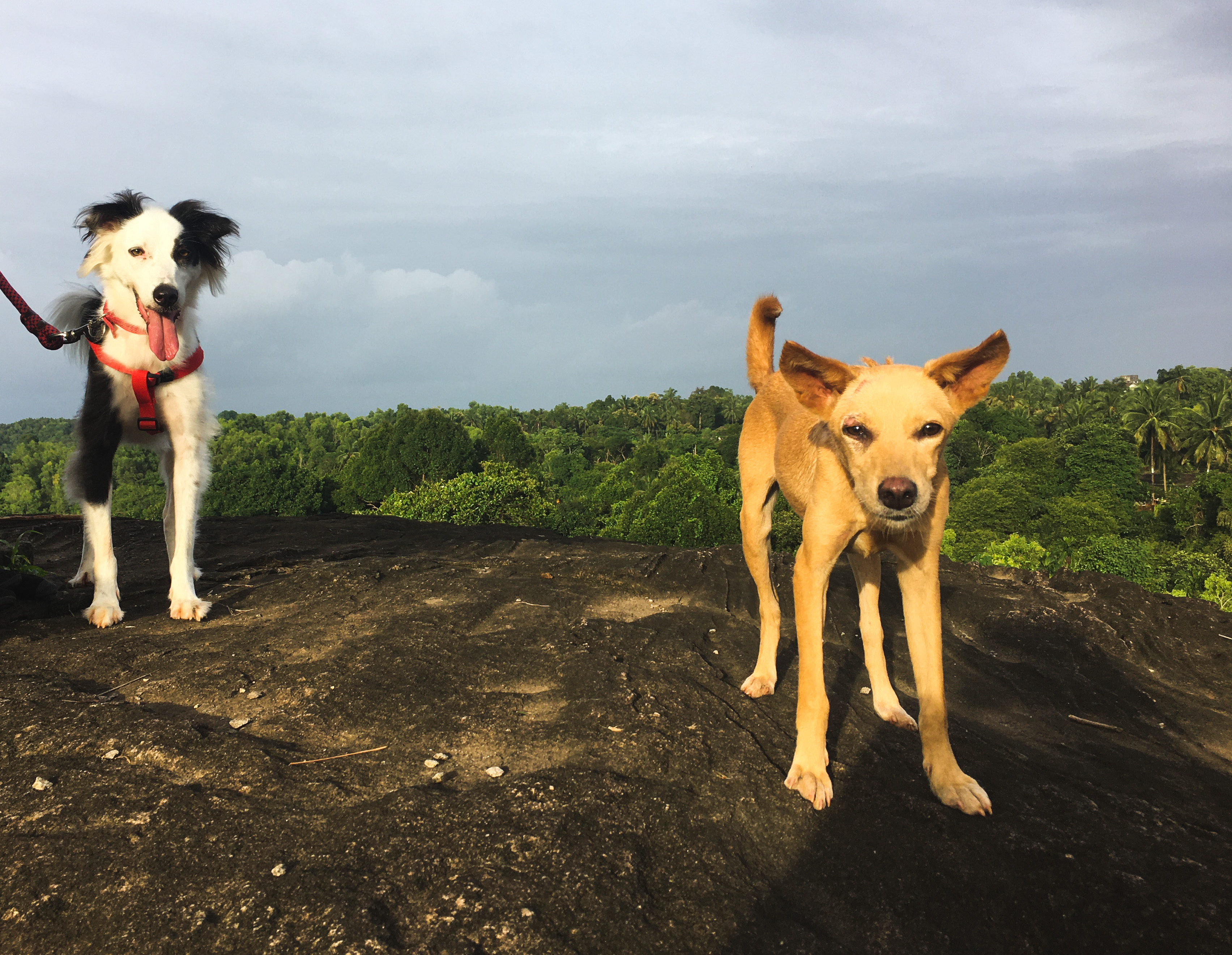


 Manisha's Blog