The pandemic of 2020 brought a brief reprieve from the wearying rigmarole of the needless daily commute, a routine that had reduced me to an automaton. It also brought me closer to my hometown, which I had left fifteen years ago in pursuit of worldly aspirations; to its abundant nature and wildlife (the latter, quite literally); to Clancy, the dog I had taken in only a few months before; and to Dian, my husband, whose long journey from his mountainous hometown to be with me evinced an endearment far greater than my feigned coldness merited at the time.
With uncertainty and anticipation, we left Bangalore for the embrace of a hometown where Mother had purchased a flat whose carpentry and painting were still under way, much to my dismay. In the interim, we stayed in the coastal town of Mulki, at Ajji Mane, the humble home of a dear auntie and our ancestral sanctuary, surrounded by sincere love, simple things, and a rich profusion of lush green.
Fascinated by the native flora in Mulki, Dian would amble around and beyond every morning, bringing back a variety of plants to “propagate” them in our respective hometowns and the cities where we worked. Wherever we meandered in the monsoons, the tropical plant kingdom exhibited its variegated opulence. One would find a singular cordate leaf of the Caladium, glazed and speckled with pink and white, rising from dense clusters of other foliage, such as the Colocasia with its matte leaves finely streaked with dark interveinal shadows. Even decaying leaves held their own charm, their brown tissues juxtaposed with the green remnants in an organic mosaic. Withered clusters from teak trees were easily detached by a breath of breeze. One such cluster (called inflorescence or panicle in botany) came to rest on the rooftop of my grandmother’s lonely abode, a stone’s throw away from Ajji Mane. Draped in cobwebs, the panicle looked divine in the sunlight as I twirled it, its hollow seeds evoking the bells of a tambourine. Halfway between grandmother’s and Ajji Mane, scarlet seeds of rosary peas still bejewelled a familiar path by a brook, their continued presence a comfort to the nostalgic.


When we finally moved to the new flat, in a new village, I began to adorn the freshly painted interiors with furnishings in the designs and colours that I fancied, my endeavour turning into a project that I now regret undertaking, as I have since moved westward.
Kodangallu is a temple village surrounded by verdant forests where leopards, monkeys, peafowl, porcupines, pythons, and other wildlife live and, hopefully, thrive. I am certain that these creatures inhabit the forests, for I encountered each one of them during my very long sojourn, except for the porcupine, though I did stumble upon its quill.
Most days were spent exploring the unfamiliar village with the eager neighbourhood children, who would never miss an opportunity to join us on our walks, even if it required them to seek permission from their parents. The young bunch was primarily drawn to Clancy, who, having instantly become the cynosure of all eyes, basked in the attention and affection lavished upon him. Among the merry group was one particularly boisterous and adventuresome boy, whose boundless energy seemed to take Clancy’s fancy, as evidenced by the celerity with which his tail wagged whenever the boy approached. The boy’s animated anecdotes also enlivened our gatherings with laughter. In time, with the children’s help, Dian learnt to converse in the local language, becoming a favourite figure among them.
Together, chasing sunsets, we discovered several nameless local gems, many of which we came to inanely christen ourselves, such as a serene grassland frequented by a murder of cawing crows at dusk—referred to as Greenland in our conversations; a hill off the beaten track offering sweeping views of the surrounding forests—nicknamed 500 Hill after Dian lost a 500-rupee note upon its shrubs; another hill from where one could embrace all the glories of a golden sunset—christened Cake Hill, because a section of the hill appeared neatly cut away when viewed from a distance, resembling a sliced cake; and a desolate terrain dotted with shrubs that attracted vibrant bugs such as the Catacanthus—nicknamed Redland for its lateritic soil.

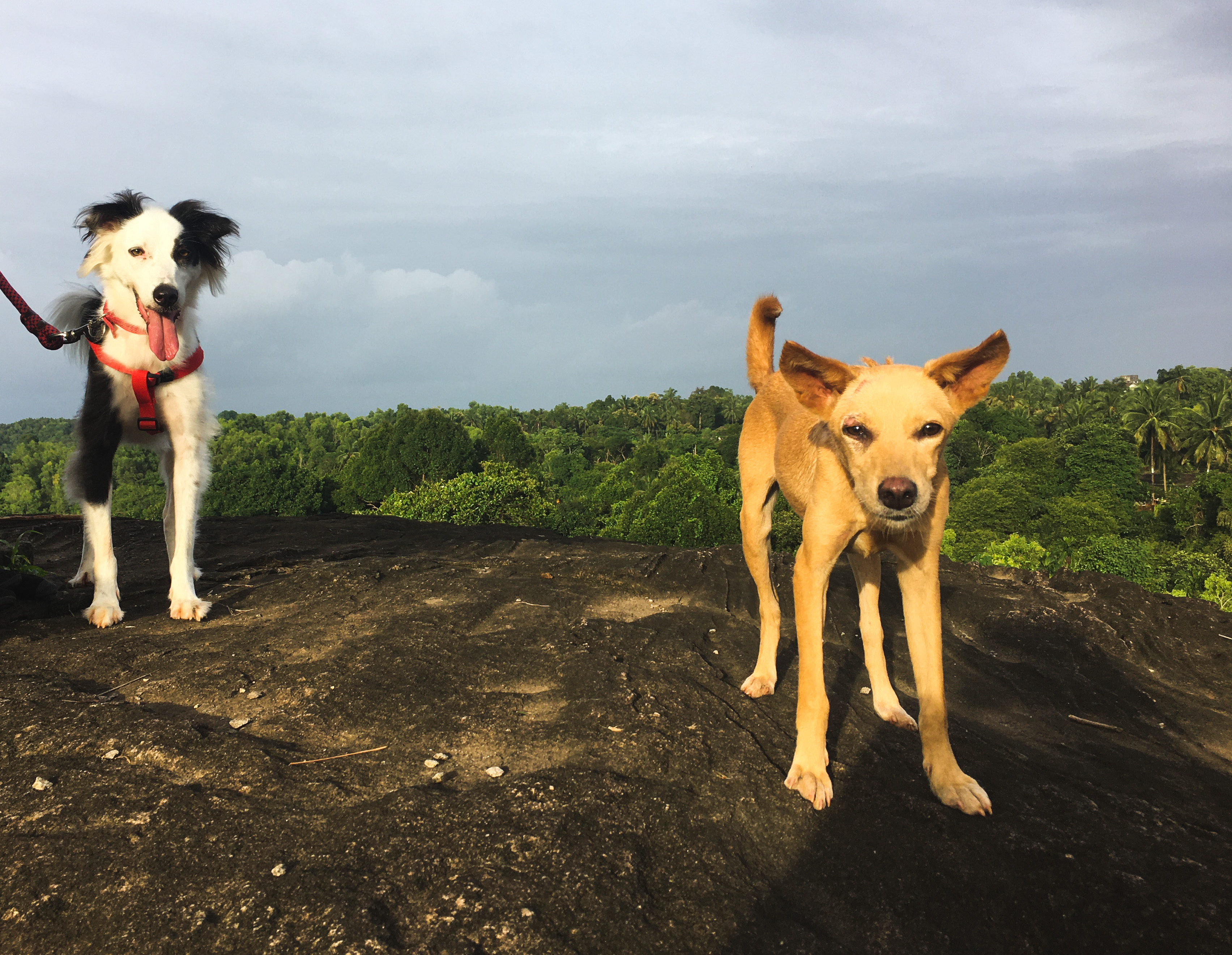
One of the places that Dian discovered through the map for our rambles was yet another hill whose local name, Naayi Basadi, translates to “dog memorial”. While we did find an ancient memorial on the modest hill, that it was erected in honour of a canine companion seemed far-fetched. From here was visible a large granite monolith called Konaje Kallu, which I had climbed as a child with my parents—our only hike together. On one side of the hill sprawled a forest, while on the other stretched coconut plantations where, looking through binoculars, one would find monkeys atop the trees, devouring coconuts or grooming one another. These playful primates were also early risers, as I discovered on New Year’s Eve 2021, when I woke up at dawn in high spirits—as though I were embarking on a new chapter of early mornings—and headed to the familiar hill to proudly watch the sun rise. Barely had I arrived when the monkeys began their ascent up the hill, resulting in my rapid retreat. It was also on this very hill that I spotted a leopard one evening! Though the sighting was fleeting, it sent me into such transports of delight that I remained on cloud nine for days, boasting about and marvelling at such a rare encounter with wildlife. As I recall this incident, I shall also record in writing a late evening when, as my young neighbour and I were approaching the flat, her sudden scream and retreat alerted me to a python lounging only a mere feet from where I stood! While her reaction was one of understandable fright, might I say that I was more exhilarated than frightened.
Some afternoons, the skies were cerulean, speckled with clouds bedazzled by the sun, and some evenings, they were kaleidoscopic and cathartic. The mesmerising ether formed an ideal sight to behold (and time-lapse) when listening to ethereal music.
On one of our rambles in an interior neighbourhood, we stumbled upon a garden with plants whose lush leaves were marked with hues of maroon and pink. Upon asking the owner if we could borrow a stem, she generously proffered several of them—a gesture characteristic of most people living there. I later learnt that this enchanting plant is called Coleus, and that the colour of its leaves depended on the soil in which it was rooted. Of all the variants of this shrub, the one that later grew in our abode was my favourite, for its leaves bore an exquisite pink, and if one looked closely on a summer afternoon, its velvety leaves glittered in the sunlight. I could easily recognise when the plant needed water, for there was a stark contrast in its appearance between when it was thirsty and when it was not. For a botanical novice like me, these little indicators were rather intriguing.

A stray puppy entered our premises, and subsequently our lives, like a radiant rainbow. Our first glimpse of her was in the moment she was struck by a car. No sooner had we reached the spot than she vanished, nowhere to be found. Days later, we discovered her outside the flat: unshaken, safe, and sound, albeit bearing an abrasion. With some love and food, she came to trust us and became our constant companion, tagging along wherever we went and whenever, rain notwithstanding. Full of beans, she was fiercely protective of the older Clancy, warding off any street dogs who approached him with suspicion. Upon this radiant pup, we bestowed the name Radium.
Inspired by Dian, who would bring home an array of wildflowers for me and wild plants for the “propagation”, I began to observe the abundant flora surrounding us, and to collect fragments of certain plants to propagate in our growing collection of vibrant pots. During this period, I also amassed a plethora of pictures of the native flora and fauna. Among the many plants I photographed was a youthful sacred fig, defiantly and beautifully sprouting amidst concrete in a college playground. Her mature heart-shaped leaves exhibited an array of green hues, while her emerging leaves were lustrous and reddish maroon. Each leaf was embellished with delicate dots arranged along her veins, evoking the image of celestial entities scattered across a cosmic canvas. She cradled more buds, each a promise of foliar splendour, until one day, when she was obliterated in the name of weeding, like other cherished elements in our vicinity.

Our next journey from Bangalore to Kodangallu carried a sense of pure relief, for we were, at last, joined by feline passengers, Dora and Mabel. Driving in a modest hatchback with a misunderstood dog and two decidedly mistrustful cats was not disruptive after all. While Dora, ever curious and adaptable, explored her new surroundings (albeit within the confines of the flat), Mabel plotted yet another escape. This time, however, her attempt was successful—she vanished into the wider woods, leaving us to ponder her fate.
Every day, Clancy tried to discreetly befriend Dora, who eventually came to tolerate his presence but never stopped hissing whenever he ventured too close. There was an undeniable joy in watching this one-sided courtship, in his tireless but doomed efforts to win her approval. There was also a certain joy in watching Dora bask in the afternoon sun reposed on a beanbag and take a siesta, in my very native land.


The abundant richness of flora and fauna, coupled with my serendipitous encounters with wildlife, was part of what made the region so dear to me. Equally significant was the chance to share the place and its experiences with my pets and with Dian, who never once minded the impromptu arrangements or the background cacophony during work. Despite never having had a dog before, he seemed to effortlessly understand Clancy (while I signed up for a training on how to read and interpret dog body language), and treated him with a tenderness that I, for all my affection, lacked. In so many ways, he was so unlike me, our differences only shining a redemptive light on yours truly. Until then, the longest time that we had spent together under the same roof was during the pandemic—an isolation that brought us together as we rambled through the tropical treasures.
P.S. During my brief absence from the village, Radium was beaten and banished by a man, because his shoes were torn apart. Failing to find her upon my return, I asked the shopkeepers nearby of her whereabouts, but none had seen her. We never learnt what became of our beloved Radium. The man, whose day job was to safeguard wildlife, had at home a toddler who was teething—just as Radium was at the time. As for Greenland, reduced to concrete, it exists no longer, as many places are, in the name of “development”.


 Manisha's Blog